Reef-safe sunscreen in Cancun: what parks, cenotes and snorkel tours actually ask for
If you're swimming at a Riviera Maya park or in a cenote, a "biodegradable" sticker guarantees nothing. What counts is the ingredient list and the written rule at each gate. Xcaret and Xel-Há ask for zinc oxide and titanium dioxide only. On Cancun's public beaches we found no specific rule, but the same logic applies.
Sunscreen with zinc oxide and titanium oxide only, per their official pages
Cenotes
Safest is no sunscreen and UV clothing instead; nearly all want a shower first
"Biodegradable"
No legal definition for sunscreens in Mexico; it doesn't replace reading the ingredients
"Reef safe"
A marketing phrase: no Mexican or U.S. authority certifies bottles
Skip
Oxybenzone, octinoxate, octocrylene, avobenzone and other chemical filters
No protection at all
Not the fix either: switch to clothing, shade and mineral rather than going bare
What each place asks for, based on what's published
We checked the parks' official pages and local press in November 2026. The table separates what an official source says from what only guides or visitor stories report, because that difference matters when you're arguing at a ticket window.
Place
What they ask
How solid the source is
Xcaret
"Only use sunscreen and sunblock containing titanium oxide and zinc oxide"
Official FAQ. Worded as a request ("we ask you")
Xplor
Sunscreen, sunblock and insect repellent with titanium dioxide and zinc oxide only
Official safety and recommendations page
Xel-Há (general entry)
Only sunscreen with titanium oxide and zinc oxide
Official Xel-Há Total ticket page
Xel-Há, Sea Trek
Chemical-free sunscreen only; a shower beforehand is recommended
Official page
Xel-Há, Stingray Encounter
Biodegradable sunscreen only; a shower beforehand is recommended
Official page. The only activity that uses the word "biodegradable"
Cenotes
A shower before entering at almost all; many want no sunscreen at all, some accept biodegradable
Guides and local press. No single rule: each ticket window decides
Sian Ka'an Biosphere Reserve
According to The Tulum Times, CONANP's visitor page lists sunscreen among banned items
Secondary. We couldn't open the official page, so confirm with your guide
Akumal Bay
The nonprofit Centro Ecológico Akumal asks for a sun shirt or biodegradable sunscreen
NGO guideline updated in 2021. Other sources report guides asking for zero sunscreen
MUSA and the Costa Occidental de Isla Mujeres, Punta Cancún y Punta Nizuc National Park
We found no sunscreen rule on MUSA's site or in sources on the national park. Several operators recommend biodegradable, rash guards or mineral
Private operators; confirm when you book
Cancun public beaches
We found no rule requiring a particular type of sunscreen
Absence of evidence, not a guarantee there are no local rules
Data verified: November 2026. Xcaret: xcaret.com/en/faqs/xcaret. Xplor: xplor.travel. Xel-Há: xelha.com/en/xelha-total. The rest, secondary sources linked at the end.
Watch out for old information. A 2015 Grupo Xcaret blog post is still circulating that describes swapping your sunscreen at the entrance for a biodegradable sample, returned when you leave. We didn't see that on the parks' current official pages. Don't count on the swap: if you forgot the right product, buy it beforehand (options below).
On how strictly it's enforced, visitor accounts contradict each other: some describe checks at the gate, others say nobody asked a thing. With a rule like this, don't bet on not being checked, especially since the real reason (the water of a closed inlet) doesn't change with who's watching.
Is there a law behind it?
As far as we could confirm, no federal or Quintana Roo rule obliges tourists to use a given type of sunscreen. What exists are each operator's conditions and rules per protected area. One academic study on the state calls regulation of these products scarce and ambiguous, and The Tulum Times notes that the decree for the Jaguar Flora and Fauna Protection Area (Official Gazette, July 27, 2022) bans discharging pollutants such as pesticides and fungicides but names no sunscreen ingredient.
Other destinations did legislate. Hawaii has barred sales of oxybenzone or octinoxate sunscreens without a prescription since 2021 (Act 104), and Palau bans products containing any of ten compounds. Mexico lacking an equivalent doesn't make those ingredients harmless; it just means the decision falls to you and the operator.
"Biodegradable", "reef safe" and "mineral" are three different things
Biodegradable: in theory, that the formula breaks down over time. For sunscreens there is no legal definition in Mexico and no official seal behind it, and breaking down slowly doesn't prevent harm while the product is in the water.
Reef safe: a marketing phrase. The Tulum Times puts it as "a marketing phrase in Mexico, not a legal standard," and no agency certifies bottles.
Mineral: the filter is zinc oxide or titanium dioxide, particles that reflect or absorb UV rather than reacting chemically with it. It's the only thing Xcaret, Xplor and Xel-Há name as allowed.
One detail rarely mentioned: a mineral is an inorganic element, so "biodegradable" isn't really the right technical word for it. When Grupo Xcaret's blog says products containing titanium oxide or zinc oxide "are biodegradable," it's using its own working definition, not a legal category. It works as a park rule; don't treat it as a scientific fact.
The label doesn't guarantee lower toxicity either. A 2020 study on aquatic life in Quintana Roo tested nine sunscreens (five non-biodegradable, four biodegradable) on four native zooplankton species. The non-biodegradable ones came out high risk and the biodegradable ones moderate risk: less bad, not harmless. Freshwater species were also more sensitive than marine ones, which fits the stricter rules at cenotes.
What the science says, and where it runs out
What's well documented
NOAA reports that oxybenzone (benzophenone-3) was "highly toxic" to juvenile corals in a 2016 lab study: bleaching, DNA damage and deformities. A 2013 study found benzophenone-2 killed juvenile corals at very low concentrations.
NOAA lists ten ingredients that "can harm marine life": oxybenzone, benzophenone-1, benzophenone-8, OD-PABA, 4-methylbenzylidene camphor, 3-benzylidene camphor, octinoxate, octocrylene, and nano versions of titanium dioxide and zinc oxide.
An estimate relayed by The Tulum Times, based on a 2021 paper, puts discharge at 231 to 313 tons of sunscreen into Quintana Roo ecosystems in 2019, and a survey found sunscreen on 4% of cenote visitors versus 29% of beachgoers.
What's still unclear
NOAA itself says how these compounds affect reefs "remains an active area of research," and that the studies focus on young corals.
In 2022 the U.S. National Academies reviewed the evidence at the EPA's request. They did not issue a list of safe sunscreens; they called for a fuller ecological risk assessment. According to press summaries, most coral observations come from the lab, and some tests used concentrations higher than any measured at sea so far.
NOAA also reminds readers that reefs suffer from warming, pollution, overfishing and disease. Sunscreen is one factor you can control, not the main one.
The same 2022 report stresses that sunscreens prevent skin cancer. The sensible takeaway isn't "stop using it" but "choose better and lean more on shade and clothing."
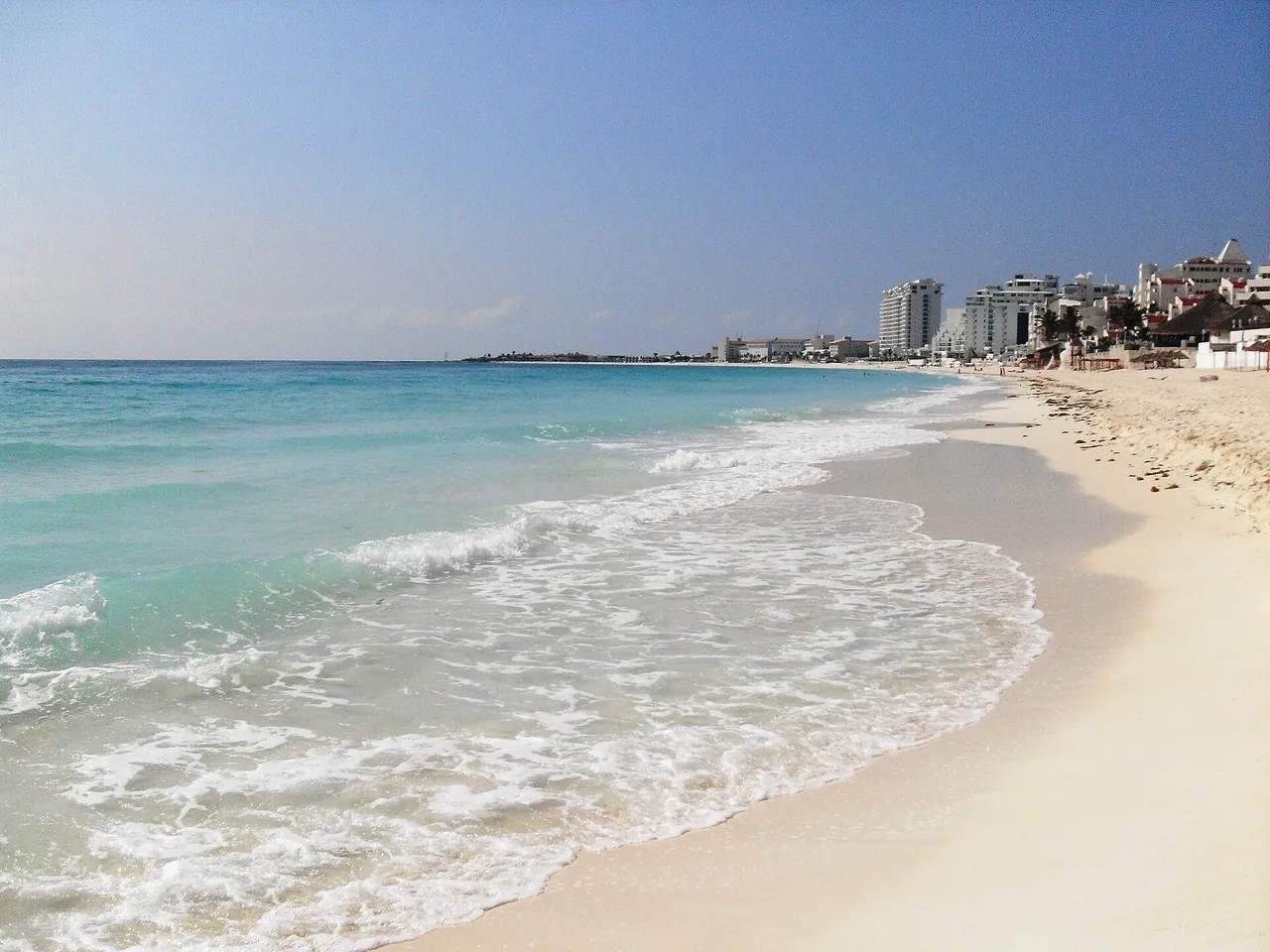
The Hotel Zone shoreline. Whatever you wear that doesn't absorb ends up, in large part, in this water.Photo: jc_castaneda · CC BY-SA 3.0
How to read a label in 30 seconds
Ignore the front of the bottle and go straight to the "active ingredients" box. If it lists only one or both of these, you meet the Grupo Xcaret parks' rule:
Zinc oxide (óxido de zinc on Spanish labels)
Titanium dioxide (dióxido de titanio), which Xcaret sometimes writes as "titanium oxide"
If any of these appear, it's a chemical filter and probably won't pass at a park:
Name on the label
Also listed as
Who flags it
Oxybenzone
Benzophenone-3, BP-3 (oxibenzona)
NOAA and Xcaret's list (benzophenone)
Octinoxate
Ethylhexyl Methoxycinnamate (octinoxato)
NOAA
Octocrylene
Octocrileno on Spanish labels
NOAA and Xcaret
Avobenzone
Butyl Methoxydibenzoylmethane (avobenzona)
Xcaret, not NOAA
OD-PABA
Ethylhexyl Dimethyl PABA, padimate O
NOAA
4-MBC
4-Methylbenzylidene Camphor
NOAA
Xcaret's list of "non-biodegradable" ingredients comes from blog posts from 2015 and 2020 (it also includes parabens, polyethylene, cetyl dimethicone and others). Use it as an ingredient reference, not as a current rulebook.
A common trap: "free of oxybenzone and octinoxate" is the standard many labels brag about, but a product like that can still contain octocrylene or avobenzone, and a Grupo Xcaret park would turn it away anyway. And "reef safe" on the front replaces none of the above.
Mineral sunscreen and alternatives: the safest bet, with fine print
NOAA considers mineral sunscreen a better option because it doesn't use chemical filters and has fewer effects on aquatic organisms. But that isn't a certificate of harmlessness:
NOAA's own list includes the nano versions of zinc oxide and titanium dioxide. A 2018 study on Acropora coral saw severe, fast bleaching with uncoated zinc oxide nanoparticles and minimal effect with coated titanium dioxide.
We found no coral tests of non-nano versions that show they're entirely safe. What ads claim often goes further than what's been shown.
Many labels don't say whether the mineral is nano. "Non-nano" is a useful signal, not a guarantee.
Minerals leave a white film and cost more. Tinted ones with iron oxide hide the cast.
What satisfies every rule at once
Clothing. A rash guard or long-sleeve shirt rated UPF 50 (it lets through roughly 1/50 of UV radiation), a hat and shade cover most of your body without any product entering the water. Grupo Xcaret's own blogs call UV-protective clothing the most eco-friendly option. It works the same at a cenote, at the park, in Sian Ka'an and on the MUSA snorkel. Save the sunscreen for your face, neck, ears, the tops of your feet and whatever fabric doesn't cover, and apply it with time to spare.
For open water, your best protection is spending less time exposed at midday. The FDA recommends limiting sun between 10 a.m. and 2 p.m. In summer the sun sits nearly overhead over Cancun, so book the snorkel for first thing in the morning.
Where to get it in Cancun
No brand recommendations: what matters is that the active-ingredient list passes, not the logo. Realistic options:
The park's own shops. Xel-Há's official facilities page says its souvenir stores sell chemical-free sunscreen. It's the last-minute fix; assume it will cost more than in town.
Pharmacies and supermarkets. The widest selection, but the dominant shelf is usually chemical filters. Look for "mineral," "óxido de zinc" or "dióxido de titanio" on the back; stock changes and we can't promise a specific brand.
Snorkel, dive and surf shops. They often carry UPF rash guards and sometimes mineral sunscreen. A good stop if you're buying the shirt too.
Your snorkel operator. Ask when you book what product they accept. Some include it or recommend one.
From home. If you already own a mineral that passes, it's the calmest route: you arrive with a product tested on your skin.
We earn no commissions and link no stores. We don't list prices because they vary by place and season: compare before you pay.
How to apply it, and mistakes that keep repeating
According to the FDA, apply the product about 15 minutes before sun exposure and repeat at least every two hours, more often if you swim or sweat. There's no such thing as "waterproof" sunscreen: "water resistant" products must state whether they last 40 or 80 minutes in the water. For an adult's body the reference amount is roughly a shot glass (one ounce); for the face, at least a teaspoon, per the American Academy of Dermatology.
Common mistakes
Putting it on in the water or in the park queue. Apply it at the hotel, with time, so it doesn't all wash off in the first few minutes.
Assuming "biodegradable" already passes. Check the actives; the word alone won't open a park's gate.
Skipping the shower before a cenote. It's the most repeated rule; it's meant to rinse products off your skin, including deodorant, lotions and repellent.
Spraying on the shoreline. Some of the product can land on the sand or blow away; cream or a stick doses better.
Applying too thin a layer. With that little you don't get the SPF on the label; use the reference amount and lean on fabric and shade for the rest.
Overlooking the repellent. Xplor puts it under the same ingredient rule; ask what's accepted at each place.
When it doesn't pay off (and this guide's limits)
If you're just lying on a public beach: we found no requirement, and any broad-spectrum sunscreen beats none. Even so, a mineral is the choice with the fewest objections.
If you have sensitive skin or travel with babies: talk to your doctor; for babies, shade and clothing come first. This isn't medical advice.
If you're headed to a cenote or Sian Ka'an: don't assume a mineral will get you in. Ask at the ticket window or your guide.
Rules change. Parks update their pages without notice, and some sources we cite predate 2021. If what you read here clashes with the sign at the gate, the sign wins.
We don't evaluate specific products. We ran no lab tests and took no field measurements; this guide summarizes published sources.
Sources and verification
Data verified: November 2026. Where to look if you need to confirm something before you go:
Still to confirm with the authorities: the Sian Ka'an rule (CONANP) and the conditions at each cenote or protected area. If you find a current rule that differs, write to us and we'll correct it.
FAQ: sunscreen in Cancun and the Riviera Maya
Is biodegradable sunscreen required in Cancun?
We found no law requiring it for tourists in Cancun or Quintana Roo. What exists are conditions set by each park, operator or protected area, and the ones we checked ask for mineral or no sunscreen at all, not simply "biodegradable."
What sunscreen can I use at Xcaret and Xel-Há?
The official pages ask for sunscreen with zinc oxide and titanium oxide only. At Xel-Há, the Stingray Encounter specifically asks for biodegradable sunscreen and the Sea Trek for chemical-free sunscreen, and both recommend showering first.
What sunscreen can I use in a cenote?
It depends on the cenote. Almost all want a shower first, and many ask for no sunscreen at all, even biodegradable. Safest is a UPF 50 rash guard, a shower, and asking at the ticket window before you apply anything.
Do "biodegradable" and "reef safe" mean the same thing?
No. "Biodegradable" describes how the formula breaks down, while "reef safe" is a marketing phrase no authority certifies. Neither replaces the list of active ingredients.
Which ingredients should I avoid when snorkeling?
NOAA flags ten, including oxybenzone, octinoxate and octocrylene. Grupo Xcaret's parks add avobenzone and others. If the actives list only zinc oxide or titanium dioxide, you meet what those parks ask for.
Is mineral sunscreen safe for reefs?
It's the option with the fewest objections, but it hasn't been proven harmless. NOAA includes the nano versions of both minerals on its list, and coral tests of non-nano versions are lacking. Clothing and shade remain the safest route.
Can I snorkel without wearing sunscreen?
Yes, with a rash guard or long sleeves, a hat, and ideally early in the morning. It's the option that satisfies every rule we found. Use mineral only on skin that stays uncovered.
Where can I buy mineral sunscreen in Cancun?
At pharmacies and supermarkets (check the back of the bottle), at snorkel and dive shops, or at the park's own store, which usually costs more. It's easiest to buy it before you leave your lodging or bring it from home.
How often should I reapply if I'm swimming?
At least every two hours and after swimming or sweating, per the FDA. A "water resistant" product only claims 40 or 80 minutes of effect in the water, so get out, dry off and reapply.
Can a park take my sunscreen at the entrance?
A 2015 Grupo Xcaret blog post describes a swap for a biodegradable sample, but it doesn't appear on the current official pages. Visitor accounts vary, so bring a product that already meets the rule.